by Fraser Hibbitt for the Carl Kruse Blog
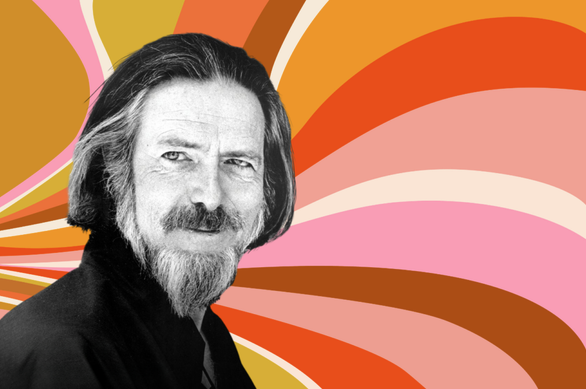
I like to think of Alan Watts’ spirit working endlessly around the clock, appearing to give his lectures every time someone streams a youtube video of him. He is drawn out from his eternal rest by AI and instinctively delivers his tender, humourous, notes on not having a self, or on the power of insecurity, in his mellifluous and solemn voice. He has no time to rest as when that is over, someone else is sampling him for a lo-fi beat and he cannot miss his mark. This is no problem for him, of course, as he promoted no-self, non-duality, and the unreal quality of this fluctuating world; but, soon enough, he’ll cry out saying christ I wish someone had recorded my drunken escapades!
Alan Watts is not too far gone and remains one of, if not the most, popular voices of those mid-century synthesizers of East meets West. Aldous Huxley is another famed example. Stricter adherents to an Eastern religion may pass over this episode in silence. Like when the great authority on Buddhism, D.T. Suzuki, met the post-Dharma Bums Jack Kerouac. Here is Kerouac shortly after the meeting: ‘I’d be ashamed to confront you and Gary now I’ve become so decadent and drunk and don’t give a shit. I’m not a Buddhist any more.’ Watts, too, criticized Kerouac’s attempt at understanding Buddhism – or, attempt to live sincerely with Buddhistic intentions. This is not your everyday Christianity.
Contemporaneously with Watts, the German philosopher Eurigen Herrigel studied Zen Buddhism in Japan for more than five years. His now famous work Zen and the Art of Archery, reaching English ears in the mid-1950s, encapsulates his time there. When he returned to Germany, he joined the Nazi party and was an ‘active’ member. Herrigel wanted very much to understand something that had eluded him in his formal education: Mysticism. Reading the book, it sounds like he glimpsed it during his time as an archery student. Mysticism is a strange seduction, precisely because it is experiential. What we really have on Mysticism is an anthology of writings from all ages about the poverty of language to communicate such a state. Then there is the question of how to continue to live within this comprehension; rather, it is felt that once Mystical insight is attained one will know how to live afterwards. Whether this comprehension is true or false is besides the point because it is experiential. Whether it is a good thing is difficult to say.
For whatever reason, Herrigel sought what was breathtakingly profound; he desired it, and you don’t get what you seek from desiring. At least in spiritual matters – so they say, time and time again. Nevertheless, he writes of this profound period in his life as a dynamic wherein his desires are thwarted, his ego lashing out, until the desire to understand gives over to the quintessential understanding without ego – Satori. In Zen Buddhism, they talk about Satori, or enlightenment, in the image of a lightning bolt; a sudden awakening that ripples through the entirety of body and soul. A threshold that one does not return from. There can be no half-satori. It is the full thing or nothing. Life after Satori is, by all means, liberation from frustrations and ambiguities by an internal gesture of the mind. Now this is profound, and if it is true that it is all or nothing, then Herrigel could not have even glimpsed it, but continued to circle the point with blinkers on. He just sensed something he desired and loved his love of the mystical. The other way says: Herrigel achieved Satori in five years through archery and then becoming a Nazi had no misalignment with Zen. Intellectually, of course, something like this happened.
What good is an insight, then? It either consolidates you to your lot or triggers a desire for change, to throw off the yoke. Herrigel thought his Western upbringing, despite a few hints here and there, to be devoid of this quality he desired, if he understood this quality then so could he be consoled. Now, the desperate demand for Buddhistic/Vedic teachings circa 1950 was for the sake of liberation. This was Kerouac’s and the Beat’s Buddhism, hence their messy restlessness, later hybridising and forming, with a whole anthology of Eastern thought, the New Age. The curious blend of many Eastern religions and philosophies with the Western mind. Huxley did his best to find the ‘perennial’ philosophy, the essence of all ethical and metaphysical understanding which is exhibited regardless of geography; but for the actors, the imbibers of this new age, it was a key for oppositional living, a stance. Alan Watts’ voice came over the radio speaking sincerely about Being, seemingly having plumbed the depths of reality, easily elucidating this weary world with new colours. If you feel life slipping away from you in suburbia, here was an answer; here, a way out. You yourself are the fit subject of contemplation and you have the power to change your mind.
It all came from the East. The U.S. slowly gorged on these foreign strains until it could assimilate them into activities like Mindfulness, and interests in yoga. It arguably didn’t make it that far, all this talk of Being and No-Self (or the Western’s mind’s frustrations of frustrations – no self?), but it cannot be denied in its subtle influences. You read Buddhistic/Vedic/Etc. leanings everywhere in contemporary mental health circles, in psychological self-help, supposedly feel it in what can only be termed spiritual exercise. But none of this is Buddhism or any other Eastern tradition, it is a birth from a clash of very different cultures; very common in history. It may feel significant, perhaps because of a historical bias, because cultural historians usually talk about these mutual influences in the formation of religions or philosophical ideas. This was a head on clash of long-standing traditions, with the undertone of criticizing and challenging the status quo, of altering the way one thinks and feels. There is nothing more revolutionary to a capitalist society than the replacing of the good Protestant work ethic for the dissolution of ego-self, of wanting release from the cycle of desire and dissatisfaction.
Now, at the end of modernity, we like to say there is no East or West, instead push for a global village, where all things subsist, interact, give birth to the new while remaining loyal to their heritage. Alan Watts is here somewhere. He is difficult to see. As another link in history, he was given the job of edited Herrigel’s multifarious notes on Zen. He straddles the line, an authority figure beloved by 60’s Beat types, introducing Zen and other traditions of Buddhism to the lay West, helped provided the general image of a guru figure. The enlightened scholar. But he himself would disagree. I am not a scholar, nor enlightened: I am a rascal, a philosophical entertainer. A song and dance man. A famous Zen saying goes: To realise Zen is to eat when you are hungry, to sleep when you are tired… Watts would add: and I drink when I want. He was no temple-dwelling soul, and that is a good thing for us. We are rarely temple-dwelling things. He came ready-made diluted of austere Eastern thought. He sounds profound as something heard for the first time – was all this Eastern thinking a façade? Was it, like Herrigel, some kind of intellectual tourism? Just another desire to be quenched? Or a hope for release from the unending uncertainty of things? It was likely all these, our fascination with this Eastern world, a poetry concise and glittering like a precious gem. One, Kerouac, bless him, never truly turned his back on: his last published book is titled: Satori in Paris. Now all we have left of Watts is the voice, cropping up in many places, some obvious, some not so. If this wheel of becoming is so, he is paying his dues, doomed to recite vague mysteries for eternity.
==================
The Carl Kruse Blog homepage is at https://www.carlkruse.com
Contact: carl AT carlkruse DOT com
Other articles by Fraser include The Color Blue, Kitsch, and One After The Truth.