by Fraser Hibbitt for the Carl Kruse Blog
The phantom colour blue exists. In the deep reaches of the sky and upon the surface of the sea. True blue pigment is so exceptionally rare…it is only the play of light reflection that we catch upon bird’s wing, or on the flower. Philologists say that ancient Greeks had no word for blue; Homer famously describes the sea as ‘wine-dark’; in fact, it seems many ancient civilisations didn’t. What does this mean? Surely not that they did not comprehend blue… that they did not perceive it so?
A boat moors at a dock in 14th century Venice. The journey was fraught; the Mediterranean Sea blows cyclones. The cargo is pulled and carted off into the dim recesses of an awning-hidden door. The box is opened. Lapis Lazuli, from the Sar-I-Sang mine in North East Afghanistan. Over 6500 kilometres. A merchant from Venice heard of the strange blue rock somewhere along the silk road, trading with the middle eastern lands. Perhaps it was the rock first, blue emerging ever so slightly from its sheets, that amazed the venetian merchant, or perhaps in passing through a market they happened on a painting, some jewellery, some artefact radiating in this unseen before blue.
They must have learned too the delicate time-consuming process of extracting the blue pigment from the lapis lazuli, and in doing so, changing art history, and perhaps too, our perception. None of this could have been known, nothing is known for the merchant besides the profit and the loss, that great admixture of human need. The blue pigment is now ready to be mixed and made a paint: ultramarine, from across the sea. Giotto, the painter pointing toward the Renaissance, colours blue the ceiling of the Scrovegni Chapel in Ravenna, the stars are dots in the vast blue heaven. Mary, always in blue. These are no faded blues of indigo that the Middle Ages knew, but a rich deep blue that finally found a fit subject. Ultramarine soon became the most expensive pigment, bearing the same value as gold.
There is a blue of late twilight where the last light dies in the presence of a pond. The wake of a duck triangles out the last beams, so white besides anything else. Silhouetted trees grow ever out of focus. The blue that only ultramarine could possibly represent, a blue that wasn’t noticed before. Likewise, there is a dreaded emptiness to life that can only be travelled with blue. Blue is never finished like the achromatic white and the deep nothing of black. It is expressive beyond belief. Picasso’s blue, many centuries later, marks the strange figures of an underworld, existing nowhere, figures that grab your dream-attention, their presence un-nerving they mutter something strange unbelievable word, before the dizzying transport of dream-logic. When Carl Jung discovered these paintings, he believed Picasso was slipping into schizophrenia, as the ever-present blue reminded him of how ancient Egyptians represented their underworld. The short-lived Ukrainian artist Dmitry Lebedev, obsessed with the colour, found in blue a gateway to the other world as well. St Paul is backed against a wall in a haze of blue; the doomed lovers Tristan and Isolde go as blue shades across a mound as the day dies.
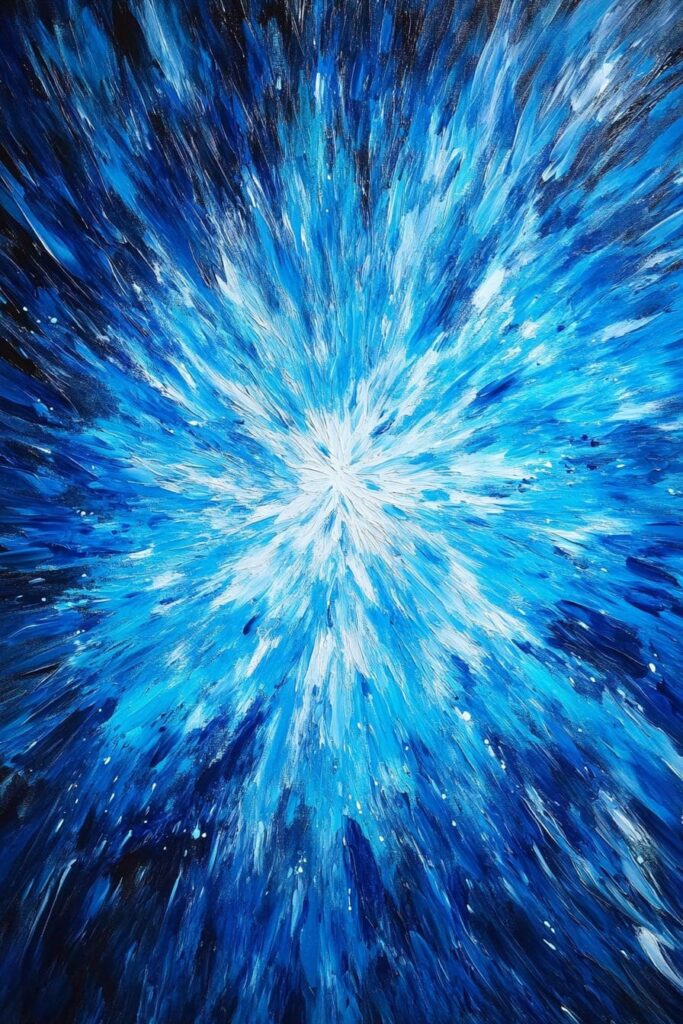
In a now largely forgotten novel from the German Romantic Novalis, our hero Heinrich von Ofterdingen dreams obsessively of a blue flower. It speaks of all that the young man longs for: love and beauty, being and the infinite. Those very qualities, so ephemeral in their comprehension, frustrating in their scope, find summation only in the dream of the blue flower. This not-of-earth born flower is the threshold to look beyond, to search for the poetry of reality. Novalis died in 1801, leaving the work fittingly unfinished. It is a curious clash of history that five years later, the chemical structure of ultramarine was first successfully analysed and captured. In another 20 years, there would be a mass of factories in France and Germany to produce the world’s first synthetic ultramarine blue.
And yet, for all that, blue still shimmers with the unattainable. It is a perfect representation of science versus poetry. We are still left wandering with von Ofterdingen, no matter how many barrels of blue are at our disposal. It is a blue colour sustaining the longing, the uninterrupted way of becoming. Picasso’s blue period ended with Cubism, with an intense perception of the world’s composition, the confusion of perspectives, the complexity of every single living moment. In the blue, there is no confusion, there is imagery symbolic or otherwise. Interpretation of symbolic imagery may lead to confusion but that is an issue of intellect, nothing to do with the honesty of the image. But the blue remains unfinished: Novalis dies en route, Picasso climbs out into another world, Giotto’s sparkling heaven remains out of reach; we cup the blue of the sea in our hands and it falls through our fingers translucent.
========
The Carl Kruse Blog homepage is at https://www.carlkruse.com
Contact: carl AT carlkruse DOT com
Other articles by Fraser include: Kitsch, Wilhelm Reich, and Knotted Brows and Sullen Moaners.|
Find Carl Kruse on Goodreads and Carl Kruse on Threads.