by Hazel Anna Rogers for the Carl Kruse Blog
There is a video from Cannes in 2002 of attendees’ reactions from the premiere of Gaspar Noe’s feature Irreversible. It’s a funny video. It makes me laugh. This video is the power of cinema condensed, the good people of Cannes frothing in anger, reeling in shock. And then there is another video, the video of Noe himself arriving at Cannes before the screening, glittering eyes, knowing what was to come, the chaos already flickering behind his teeth, smile of a devil.
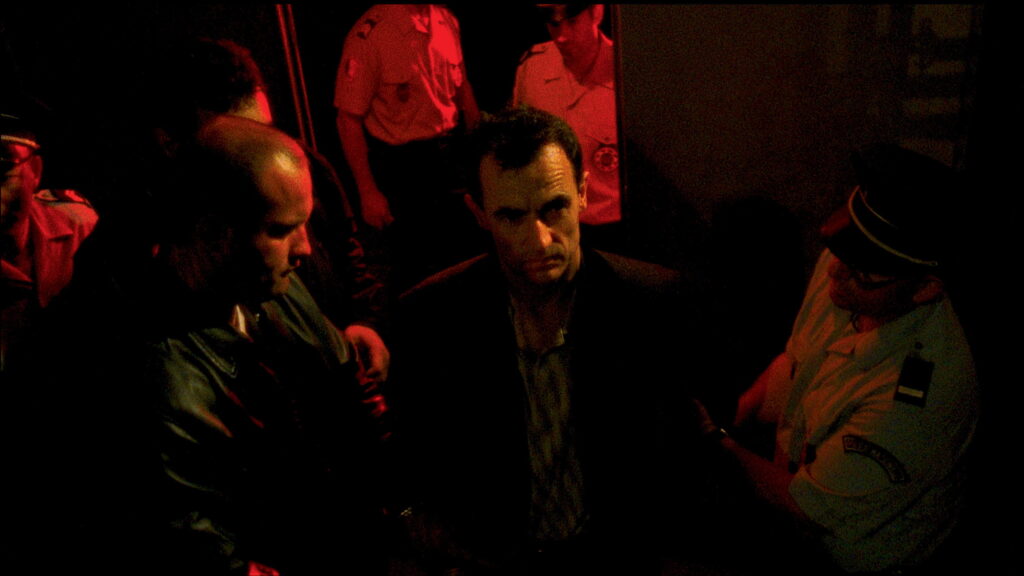
I watched Irreversible a few days ago. I am unsure of where to begin. Perhaps we will begin at the end, as is the shape of the film. A camera twirling in the red light, arriving in a room, barren, filth, a naked man talking to his friend, he raped his daughter, he says, she was all he had left; it’s human nature, his friend tells him, time destroys all things. We twirl out and into the redness of the gay club, The Rectum, where Marcus (Vincent Cassel) is being wheeled out on a stretcher, followed by his friend, Pierre (Albert Dupontel), who is being arrested. It is vertigo, vertigo in reverse, we turn back in time again, Marcus is no longer comatose, he is raging through The Rectum looking for a man called La Tenia, the turning of the camera punctuated by the bodies of men in the dark, moans and shrieks of sex, and then violence, unflinching. Back in time we go, we see how Marcus and Pierre got there, got to the club, and we reach the moment, the one for which the good people of Cannes so raged:
Scandaleux! C’est lamentable de faire des choses pareilles! Voir une femme se faire violer pendant vingt minutes!
[Scandalous! It’s deplorable to do such things. Seeing a woman be raped for twenty minutes!]
C’est un malade mental.
[He’s mentally ill.]
Viens me voir. T’es une merde, Noe.
[Come see me. You’re a shit, Noe.]
C’est dégueulasse.
[It’s disgusting.]
And, of course, it is disgusting. The rape of Alex (Monica Bellucci) in Irreversible is the most viscerally repugnant one I’ve ever seen on screen. And there are nine whole minutes of it. I muted the volume when it was on. I couldn’t handle the noise. But, despite my repulsion, I felt the scene was done well. No distraction, no movement of the camera, just the act, the terrible act. I think we forget what the word rape means, sometimes. We throw it around, it loses its veracity, we lose the capacity to understand the gravity of it. A rape is reported every hour to the police in London. Perhaps you do not understand what this means. Perhaps I do not either. A rape is a moment in time, five minutes, ten minutes, twenty minutes. A fragment of a life. A fraction of a day. But it takes it all with it, because it is not so short. It is, rather, a lifetime. A time that destroys all things.
Extremist cinema is often difficult to reason with. Maybe Noe needn’t have shown the rape so graffically, nor for such a long time. But it’s his style, it’s his wide open eye, seeing everything, forgoing nothing. He scars the retina, images tattooed on the optic nerve. Noe is a provocateur. And it is cinema, lest we forget. We have become desensitised to violence because we are used to seeing snippets of it on our social media channels, and we have the ability to scroll away from it, to click onto something more pleasant, blink of an eye and it’s gone, the suffering of the world deleted. In cinema, filmmakers have the capacity to confront us with the horrors of the world in an enclosed space, and we cannot escape, we cannot escape Alex’s terror, and it is terrible, and it is terrible.
There are levels to extreme cinema. On the far end, the extremist end, we have Mondo film, ‘shockumentaries’ consisting of compiled veritable and staged footage of worldly cultural practices, including extended sequences of animal cruelty, taboo rituals, sexual exploits, and bodily harm or surgery.
Also on this end of the extreme film genre, we have Balkan Shock Cinema, of which the most notorious film is, of course, A Serbian Film (Srđan Spasojević, 2010), the story of an impoverished porn star who gets tricked into participating in a movie involving sexual abuse of minors and necrophilia. Around this time – the 90s into the early 2000s – we also have the wave of New French Extremity; this is where Irreversible comes in. The films on this end of the extreme filmic spectrum are unremitting – unwavering violence, sickening scenes of exploitation, and general uncut filth. They’re showing a world which those of us sat tight in our plush theatre seats have likely never encountered, nor perhaps even thought about. An underground world of seediness and hate and mindless violence. We are also confronted with themes of gendered violence, racism and classism, and the complicity of institutions in adapting to, or even perpetuating, violent acts in communities. Notable on this last point is the documentary The Act of Killing (Joshua Oppenheimer, 2012), which chronicles the mass killings in Indonesia between 1965-1966 by members of small communities, dubbed ‘gangsters’, acts of murder which were actively funded by the US, UK, and Australian governments due to their fear of communism spreading throughout Southeast Asia.
Towards the more ‘gentle’ end of extreme cinema, we have the films of Lars von Trier – Idioterne (The Idiots, 1998) is a black comedy that follows a group of adults feigning disability and mental incapacity as an anarchic philosophical stand; the next ‘evolution’ of man being, they propound, stupidity. We watch the group negotiating social situations in feigned states of ‘idiocy’, in an attempt to find simple, innocent joy in a soul-crushing world. What’s the idea of society that gets richer and richer when it doesn’t make anyone happier? It’s a riotously funny and equally uncomfortable watch, particularly from the perspective of our modern sensibilities; watching grown adults ‘spassing’ and having gangbangs, all shot in the raw texture that is the mark of the Dogma 95 manifesto, is pretty damn entertaining.
In watching these works of extreme cinema, we are invited to participate in the acts we see on the screen; as viewers, we are complicit in the violence – we have paid money to see it, after all.
Anna: Why don’t you just kill us?
Peter: Don’t forget the entertainment value. We’d all be deprived of our pleasure.
‘Funny Games’, directed by Michael Haneke, 1997
Our nausea, our disgust, our enragement at a director for his audacity to show such things on screen – the collective trauma of experiencing a work of extreme cinema is indeed an invitation to explore our own moral shortcomings, and our ignorance of rampant societal issues, such as rape culture, as in Irreversible, the omnipotence of Western governments over the politics of other countries, as in The Act of Killing, and the dangers of fascism, as in Salò, or the 120 Days of Sodom.
I don’t have such a strong stomach as to be able to watch a lot of extreme cinema. My eyes smart at the body horror of Cronenberg, my body gets rigid, palms wet at the hot revenge and cut-throat savagery of Oldboy, Irreversible, and Straw Dogs. But I’m interested in it, in the audacity of extreme cinema, or at least cinema that shows it all, blood and guts and skin in 4k resolution. Cinema is still young, we’ve had barely a hundred years of it, and it is ever evolving, a living creature stretching out its arms, asking for us to innovate, to go further, harder, braver into its embrace.
Now that we’ve seen it all, or think we have, what with the aforementioned stages of extreme cinema and the snuff entries into the horror genre, the absurd surrealist madness of directors like Alejandro Jodorowsky, the dreamscapes of David Lynch, the various New Wave movements, all abrupt cuts and existential youths, the sleaze of postmodern America with its Pulp Fictions and its Fight Clubs, the kitchen sink realism of Ken Loach and Andrea Arnold, lives in disrepair, the brutal honesty of Italian Neorealism, men on the street…where are we now? Where are we going?
Extreme is dead – Gaspar Noe ate it and threw it back up into our faces, and we loved every second. Extreme is something different, now. Extreme is the blotting out of the colossal stream of nostalgia, a blindfold in the face of what has come before, a need for the pure artist, who am I when I am not on my phone? Has my phone killed my head, and what does a killed head make with a video camera? Or is extreme a return to the old, Mark Jenkin’s black and white, New Wave Cornish cinema, one word sentences and the sensuality of the object, mobile phones pictured in grainy 16mm monochrome, modern and ancient ribbons tied up and spilled out like confetti. Or is it Joseph Archer, with his Snapshot, kill the rectangle of cinema, shoot it all in a circle, the circle is where it’s at, peripheries shut out, closed off, only the essential, only the centre of the screen alight, we’ve gotten greedy with our big rectangular screens, this is real restraint, this is extreme cinema. Or is it streaming services, pump out churn round again and again and again, more more more, better better better, younger thinner plastic princess, this is what Gibson said, a relentless Darwinism of fashion, people becoming archetype[s] cooked down from the major media faces of the previous five years, this is extreme cinema, a cinema that never stops, scare away the darkness with the brightness of the television screen, scare away the depression with the never-ending beauty, numb the mind with neon, we need never think again.
Who knows.
======================
The homepage of the Carl Kruse Blog is at https://www.carlkruse.com
Contact: carl AT carlkruse DOT com
Other articles by Hazel include The Death of Fantasy Film, Sex Drugs and Robert Crumb, and on Ageing Actresses and Beautiful Women.
Carl Kruse maintains another blog here and is TheCarlKruse on Facebook.