by Hazel Anna Rogers for the Carl Kruse Blog
Thatcherism, Reaganomics, Vietnam. David Bowie, Lou Reed, Spandau Ballet. Wall Street Bankers, The Christian Right, The Cold War. Labyrinth, The Never Ending Story, The Last Unicorn. Chernobyl, The Ozone Hole, The War on Drugs.
I’m thinking how to start all this.
I got to thinking about it while writing about movie posters. I got to thinking about sweet spring nights, budleia and rose, first love beside me, so in love I can’t breathe, VHS of Labyrinth playing on the old black 14” Panasonic, and that scene, the masked ball, Sarah in her pink-puffball-princess dress, jigot sleeves big as angel wings, Jareth in his bedazzled midnight-blue justaucorps and ruffle-necked silk shirt, monstrous masks, ghouls in the night, goblin men, mouths agape; then the song, twinkle down lullaby, New Romantics, lost in the crowd, found again, longing, longing, dancing, love, I have so much love it is falling out of me like dust from a star, and then the boy before me told me I was beautiful, and I cried.
I went through memories, and I got to thinking about fantasy.
The decades of history are siphened apart through the lens of film, of music, of literature, of art – these the means with which we translate the chaos of the time we live in, because history doesn’t always tell a straight story.
In the 1960s, Conservativism, the Vietnam War, the struggle for racial equality, the birth of the teenager – from these ground-shattering beginnings were thrust forth Andy Warhol’s pop-art and its commentary on consumerism and celebrity; the political critique of French Nouvelle Vague Cinema and the graphic sex and violence of the films of The Hollywood Renaissance; and the boom of sci-fi immortalised in Philip K. Dick’s post-apocalyptic Do Androids Dream of Electric Sheep and Anthony Burgess’ anti-establishment masterpiece A Clockwork Orange.
The 1980s, coloured grey from the austerity promised and delivered by Margaret Thatcher’s iron fist and Ronald Reagan’s laissez-faire capitalism, from the billowing clouds of radioactive isotopes floating from Chernobyl towards Europe, from the sickly scent of burnt bodies left decaying on Vietnam soil – all of this grey brought in a great tidal surge of artistic response, a tsunami of colour to drown out the terrible grey of the world.
It was here that we met with Fantasy in its most flamboyant, wondrous, escapist form. J.R.R. Tolkien’s death in 1973 was perhaps the start of it all; when a great artist dies, he is reborn again; new eyes find him for the first time, old eyes delve gluttonously back into their obsession. Then, in 1974, the game Dungeons & Dragons (D&D) was released, to enormous popularity – much to the chagrin of the “Satanic Panic” proponents (mostly from American Christian communities) who had been urged to take up arms after a surge in ‘occult’ media in the 1970s and late 60s (Polanski’s Rosemary’s Baby (1968); Friedkin’s The Exorcist (1973); the growing taste for rock music, particularly those who imbued their performances with ‘satanic’ imagery, such as Black Sabbath; and Mike Warnke’s novel The Satan Seller (1972), a falsified memoir claiming he was leader of a widespread Satanic cult who committed such attrocities as human sacrifice).
From the 70s to the 80s, the popularity of the dark, the fantastical, and the occult merely strengthened its hold, but took on a more profound political meaning. Fantasy films of this decade are moral tales, stories of good and evil, metaphors for the great terrors of the decade; the threat of nuclear annihilation, as immortalised in The Neverending Story’s ‘The Nothing’:
“The Nothing is the emptiness that’s left. Like a despair that’s destroying the world.”;
And, further, the fight against dictatorial and right-wing political leadership, as modelled by the terrible Prince Humperdink of The Princess Bride; but also, sheer blissful escapism – with the divisiveness brought about by the Vietnam War and the Watergate scandal, the watching public desperately needed heroes (I’m looking at you, Wesley) – stories of bravery and triumphant good, with clear moral boundaries.
The teenager, who came into her own during the 1950s in full force, only grew in independence throughout the following decades, establishing her tastes as distinctly separate from those of her parents; in Labyrinth, we see a villain – David Bowie’s Jareth, the Goblin King, as “the demon lover conjured by a teenager’s imagination [.] [H]e’s at once predatory and preening, wounded and yearning” (Justine Elias, “The Micro Golden Age of Mid Eighties Fantasy Films”, from The Arts Desk).
The surge in the dark fantasy genre also took its inspiration from trends in music and fashion of the time; Vivienne Westwood’s ‘Pirate’ collection of 1981 brought about a renaissance in gender-fluid attire – we’re talking Rococco opulence, 19th Century ruffles, and men with makeup; this was the birth of the New Romantics, fed up with the grit and dirt of the 70s, in cinema and in music, and shaped by ongoing social movements to protects the rights of gay and queer people. Think of David Bowie in Labyrinth: skin-tight leggings, heeled boots, leather waistcoats, long blonde hair, eyeshadow. Traditional right-wing masculinity was being torn to shreds, one Duran Duran song at a time.
Anyhow. Kind of why I wanted to speak about the heyday of fantasy, and particularly dark fantasy, is because I don’t know if it has the capacity to exist anymore – at least not in the same way as it did in the 80s. Sure, we’ve had some sweet fantasy since; early inceptions of the Harry Potter franchise embraced the mess and chaos of old-school fantasy, and scenes were graded with a pleasingly warm palate of oranges and browns. The oft-forgotten Stardust, Matthew Vaughan’s fantasy epic from 2007, is a deliciously classic fantasy, with witches and princes and old-English villages aplenty. Then we have Hayao Miyazaki’s films animated films, which raised me and which I often return to – they strike a most perfect balance between the wondrous, the bizarre, and the ecopolitical; but, again, the film of his which I return to most often is Nausicaa of the Valley of the Wind, a tale of an earth destroyed by human violence, which is from the decade in question – it was released in 1984.
I’ve previously spoken in other articles about society’s general lack of ‘wonder’, particularly in younger generations. CGI has overtaken the puppetry, animatronics, and general physical effects of earlier fantasy and sci-fi films, which I think already casts a clinical shade over the genres – automatically, we are brought out from the film, because CGI has a specific composition about it which tells us it isn’t ‘really there’ – it’s too real for reality. The Dark Crystal, an entirely animatronic film, is captivating because we are engrossed in the world of physical puppets – we become immersed in their movements, the way they speak, the way they interract with the fantastical world around them.
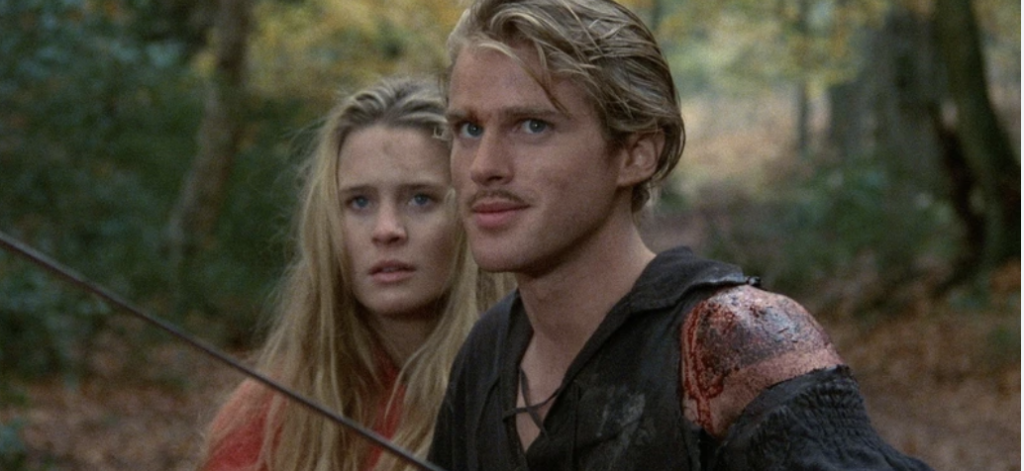
The beauty of 80s fantasy is in its whimsy, its absurdity, its aesthetic complexity, and – perhaps most importantly – it’s messiness. Actors are varied in face and body: Andre the Giant in The Princess Bride, enormous and soft and deep-voiced; Warwick Davis in Willow, standing at only 1m 07cm as a result of Spondyloepiphyseal dysplasia congenita (SED); Robin Wright in The Princess Bride, androgynous beauty, cat eyes. We fall into these worlds because they are populated by people with texture, with wonky noses and short legs and crooked teeth and smiling eyes. The settings, too, are disjointed, crude, messy – think The Bog of Eternal Stench in Labyrinth, or the janky torture device in The Princess Bride. It’s filthy, at times cheap-looking, but always palpable, always in keeping with the world of the film. These films are so deeply enjoyable because they are so very sincere; for what is more sincere than Inigo Montoya speaking the lines:
“Hello. My name is Inigo Montoya. You killed my father. Prepare to die.”
We lack sincerity these days. In fantasy – such as the superhero movies of Marvel or DC – directors and screenwriters feel a compulsion to imbue the script with tongue-in-cheek self-awareness, with cheesy one-liners and references to reality, to the modern world. Everything is a joke, everything is nonchalant, everyone is too cool to care. And it ruins fantasy and sci-fi. If you choose to dismiss the world you’ve built with lines that indicate an ‘above-it-all’ relationship with the genre at hand, then how can you ask me to partake in the film with genuine earnestness? All my awe, all my wonder is lost when you make a mockery of my joy, my escapism, my love for cinema.
And is it possible for younger generations to feel wonder? Bombarded with AI creations, non-stop cartoons, iPads at the dinner table, movies in classrooms – they’re used to it all, now. Small beauty brings quick boredom. Where are we going? Where can we go from here? How can we make eyes widen in wonder that have already seen it all?
In my view, old-school fantasy still begs an audience. It is no wonder we are so nostalgic; the clinical crispness of modern movies and TV negates the warmth we have historically derived from these respective art forms. But I think the novelty of a new fantasy, a new sci-fi with a hand-built set, wonky actors and wonkier props, and a commitment to the story that rejects an awareness to this age of technology, would resound well with audiences. I know I’d go and watch such a thing at the cinema.
===================
The Carl Kruse Blog homepage is at https://www.carlkruse.com
Contact: carl AT carlkruse DOT com
Other articles by Hazel include Sex, Drugs and Robert Crumb, A Year In Books, and Otherworld vs Underworld.
Carl Kruse maintains a feed on Tumblr.