By Asia Leonardi for the Carl Kruse Blog
This is the first in a series of articles intended to draw a brief panorama of the moral theme in contemporary philosophy. I will deal, using simple words, with the arguments of the great philosophers of history, engage in dialogue with them, try to understand what morality means in their thinking, where do human beings fit in the design of the world, what meaning our actions have. I will immerse myself in their speeches: my goal is to have a dialogue with their voices.
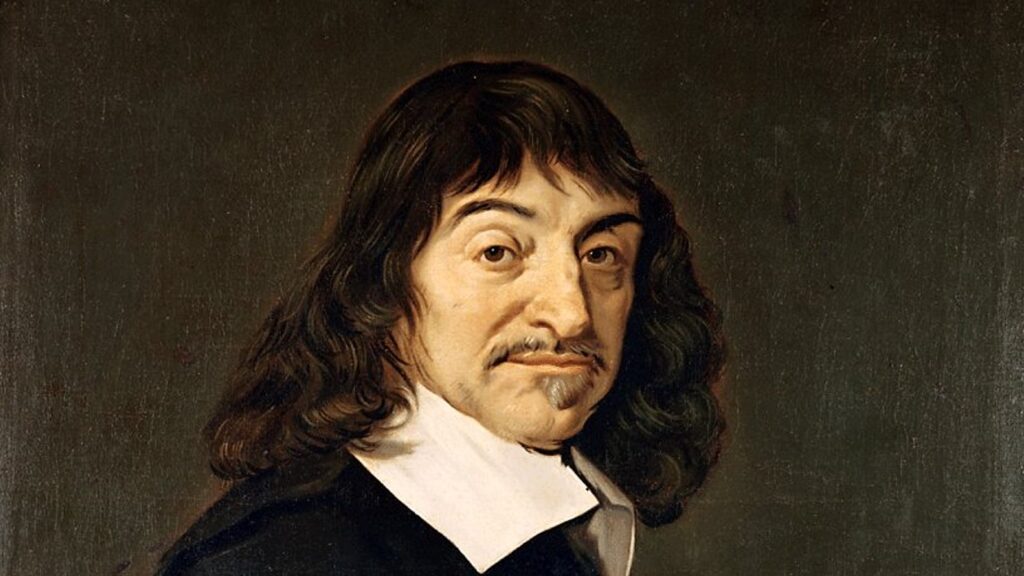
The first stop on this route is René Descartes. The texts taken into consideration are the Philosophical Meditations (in particular from the first to the fourth) and the Passions of the Soul.
MEDITATIONS ON FIRST PHILOSOPHY
The purpose of Descartes, in the Meditationes de Prima Philosophia, is to form a discourse on God and on the soul intelligible even for those who do not believe: that is, starting from rational discourse, giving proof of truth with natural reason (and not on revelation).
The God of revelation offers himself to human reason to be known, even more certain than sensitive entities. To believe, for Descartes, is a form of knowledge that is connected with reason. The idea of God and the soul are the moral controllers in our life: their certainty prescinds and indeed guarantees the certainty of the outside world.
THE GREAT HALLUCINATION
But let’s start from the beginning. With the help of the “reasonable doubt” Descartes begins to examine and reject all those things that do not bring evidence to reason, that is, they are not perceived clearly and distinctly to the point that they cannot be questioned.
The starting point is the fallacy of the senses: I can see a stick immersed in water as deformed, and see it broken when in reality it is perfectly intact. Or how many times, during a dream, the sensations felt seem so true, the visions so vivid that we are convinced that we are living them?
But if the senses deceive me once, how do I know for sure that they don’t always deceive me? How do I know when I’m dreaming and when I’m awake? Of course, mathematical truths appear true both in waking and in dreaming, I cannot dream of a round triangle, just as the fact that 2+3 equals 5 is true both while I dream and while I am awake. But how can I be sure that there is not a deceiving God, an “evil genius” that deceives me perpetually, also every time I do 2+3? This hypothesis also takes away certainty from mathematical laws!
But won’t I be something at least? Or maybe I’m so attached to the body and senses that
I can’t exist without them?
And yet, even if there was a deceiving God who is deceiving me, that would mean that
he is deceiving me, I am part of the equation, I exist.
As long as I think, as long as I feel, as long as I have a punctual perception of my existence,
I exist: even if I hallucinate and anyone tells me that what I see is not real, no one can
deny that I am hallucinating!
The cartesian “cogito ergo sum” is not just pure thought: everything I imagine, I think, I
perceive, refers unequivocally to a certainty of me. The immediacy of my being precedes
every other evidence of the outside world, even the evidence of God.
THE EXISTENCE OF GOD
To take the next step we need to explain a key concept of Descartes’ metaphysical
rationalism: innatism. According to this thought, there are certain ideas in our minds that cannot come from sensible experience but are imprinted in us from birth.
The idea we have of God, for example, is that of an infinite, eternal, immutable,
omniscient, omnipotent, and independent substance.
But how could we have derived the idea of infinity from our human experience? We may
have deduced it as a consequence and negation of the idea of finite (i.e., I call infinite all
that is not finite, but I have no idea of what is infinite).
Descartes, however, corrects himself: the idea of infinity must precede that of finite: how
could I have perceived myself as finite, imperfect, if I did not know the meaning of
infinite and perfect?
All the determinations of God (as “ens perfectissimum”, that is, an entity that has in itself,
in act, all perfections) are, for Descartes, innate ideas, placed by God in our minds as the
mark of the craftsman on his work. God, in short, wants to be known, he is not envious,
and he has nothing to fear.
But if God is a very perfect being, so he cannot miss existence, he cannot be subject to
any defect: therefore, he cannot be a deceiver. On the contrary, he is the guarantee of
the truth of creation, it is a good God who does not want to keep anything hidden from
us.
THE ERROR
However, even though I recognize that God never deceives me, I frequently fall into
error, and in my experience I continually perceive my finiteness and imperfection as an
entity.
If a perfect God cannot generate imperfections, this means that error is a typical human
condition. Descartes speaks of error as a lack (a lexicon that recalls that of Saint
Augustine), in his exception not of “negation” (that is, as not having something due to
us), but as “deprivation”, or rather incompleteness of certain knowledge.
In our human mind, in fact, in addition to the idea of God, we also experience the idea of
nothingness, or which is as far as possible from any perfection. “So I understand that I
am something between God and nothing, or that I am so placed between the highest being
and not being”.
We speak, therefore, of the median condition of man: man is never only man – he can
become more beast than beast itself or praise himself to God. Heidegger will call it the
“ecstatic condition of being”, always being outside of oneself.
My error cannot come from a single cause (otherwise it would be positive), but from the
competition of two causes: the facultas conoscendi (the intellect) and the facultas
eligendi (the will).
THE WILL
Our will consists in our ability to decide whether or not to do something, but also in
agreeing or not on an idea posed by the intellect, in judging true or false the external
premises of sensible reality.
Spontaneity is the essence of human freedom: when we are faced with clear and distinct
ideas – such as mathematical laws – we can do nothing but believe them to be true.
It is precisely in the will that man can be said to be godlike: the will of man is infinite,
but he is faced with a world already created and that he must only know (his thought
must be a cognitive thought and not creative).
While the divine intellect is an archetypus intellect, an intellect that in thinking puts into
being, accompanied by the will – infinite – to do so, the human intellect is an ectypus
intellect, a finite intellect that can only know. The human will is infinite like the divine
will, and it wants much more than the intellect can give, and that is the friction that
causes the error.
Descartes deduces that our mistake does not lie in the fact that God made us in a certain
way, but that despite He made us in a certain way, we claim to be made like
him.
God could have made me free and yet never let me to deceive myself: but in this way, I
would have been perfect, a whole; in a universe where all the parts are perfect there is
only room for God.
Any part of the cosmos would be God, and I would identify myself with the divine
substance.
Anaxagoras argued that if the universe had only been dominated by Love (the principle
of the union) and if all the substances had been cohesive among them, there would have
been no vital movement, no one would need anyone, and it would be a dead world.
Descartes constructs a drawing of the cosmos where imperfections are completed, they
bind together creating a cosmic order, an order that foresees the gradualness of being:
what is a defect (my imperfection) is a cardinal principle of the universal order.
It is therefore our duty, according to the thought of Descartes, to recognize ourselves as
imperfect and finite beings, to recognize that we do not possess infinite knowledge nor
that we could ever obtain it: divine designs are beyond our understanding. The veracity
of our understanding of the outside world is guaranteed by God, but we do not have the
power to compete with him; therefore, it will take a proper disposition of will
concerning our acting and thinking in the world.
This means that we must not fall into too hasty judgments, that we must take as true
only the things that are perceived clearly and distinctively because we cannot claim to
have a certain knowledge of the rest. Similarly, we can deduce that the discourse
expands on which is good: according to the thought of Descartes we can judge good only
what is perceived by us as good in a clear and distinct manner, and we should reject
what is not perceived in this way.
However, Descartes did not dwell long on the moral direction of our actions. In his latest
work, “The Passions of the Soul”, we find a brief disclosure on the subject: Descartes deals
with passions (such as love, hate, desire, joy, and sadness) that by their nature are all
good, but that we must prohibit the bad excess. Here too, it is a correct and moderate
use of our will. It must intervene indirectly “by making firm and precise judgments about
the knowledge of good and evil” (Art. 48)
Descartes takes a lot from the stoicism of Seneca, particularly dwelling on the stoic ideal
of self-sufficiency.
But the will is so free by nature that it can never be constrained. And of two sorts of
thoughts which I have distinguished in the soul, whereof some are her actions, to wit
her wills; others, her passions, taking that word in its general signification, which
comprehends all forms of apprehensions. The first is absolutely in her power, and
cannot, but indirectly, be changed by the body; as on the contrary, the last depend absolutely upon the actions which produce them, and they cannot, unless indirectly,
be changed by the soul, except then when her self is the cause of them. And all the
action of the soul consists in this, that she merely by willing anything can make the
little kernel, whereunto she is strictly joined, move in the manner requisite to
produce the effect relating to this will. (The Passions of the Soul, Art.41)
However, the world is not divided into good and evil, nor can there be an accurate way
of choosing what is 100% good: simply because it does not exist. Nor, in our daily
activities, can we afford not to choose: we would remain motionless, solidified in doubt;
we cannot claim that there is something good, that our action does not bring, albeit not
wanting it, Something that’s not good for someone else. Simple actions can lead to
consequences we didn’t mean.
To quote “The Good Place”, nowadays “Just buying a tomato at a grocery store means that
you are unwittingly supporting toxic pesticides, exploiting labor, contributing to global
warming. Humans think that they’re making one choice, but they’re making dozens of
choices they don’t know they’re making.”
============
The Carl Kruse Blog homepage is at https://www.carlkruse.com
Contact: carl AT carlkruse DOT com
Other articles by Asia Leonardi include High Rise, The Height of Decadence? Lisbon Diaries, and The Mandrake: Between Myth and Truth.
Carl Kruse is active in the “Numbers Fields” project over on BOINC.