by Fraser Hibbitt for the Carl Kruse Blog
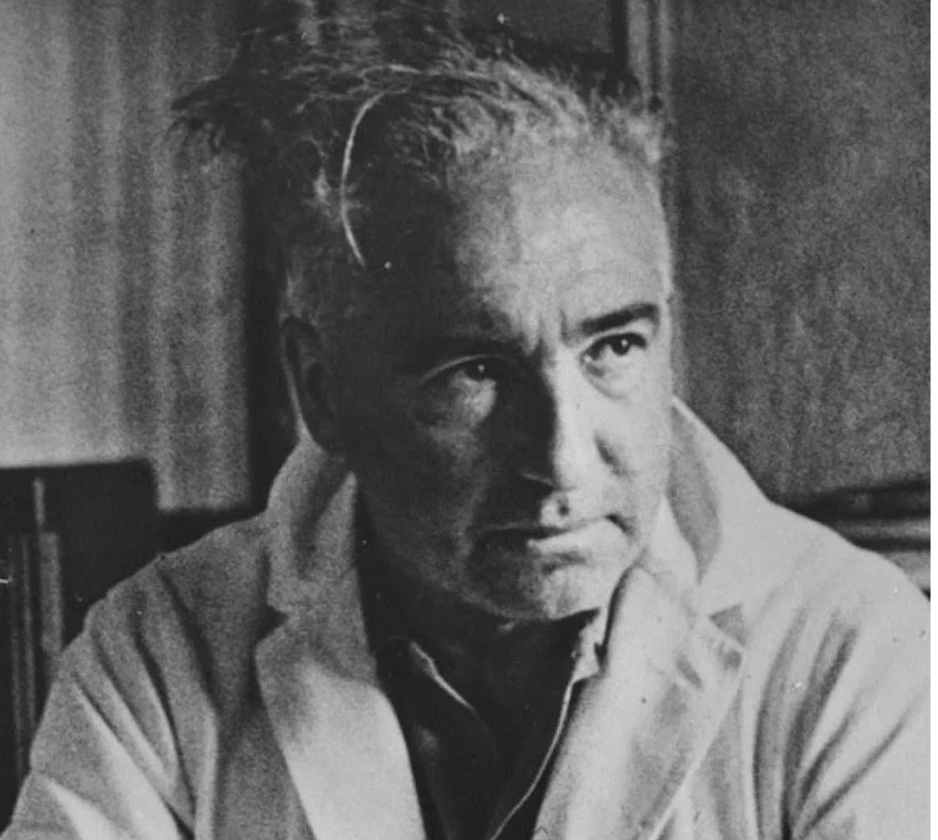
Wilhelm Reich marked U.S. history as being the target of the only federally sanctioned book-burning. Six tonnes of it in the mid-1950s. Ray Bradbury’s Fahrenheit 451 had been published three years earlier and the Beat Generation were somewhere across the country. Reich would die soon after the book-burning, in 1957, alone and in jail, and so ended the backlash that followed him throughout his life. His daemon diminished but not stamped out.
In 1919, Wilhelm Reich met Freud. He was 22, still an undergraduate, interested in sexology, and he made a sizeable impression on the father of psychoanalysis; Freud remarkably allowed him to meet with patients. Reich made distinct and respected contributions to psychoanalysis during the 1920s, earning Freud’s satisfaction, and to the larger psychoanalytic community was seen as a gifted clinician. His thought on ‘body armour’ can be seen as a proto-somatic therapy, one that would become restated in light of trauma studies. During his time with patients, Reich grew more interested in their bodies, felt that perhaps neuroses lived locked up in the way they clench, resist, tighten – perhaps language was not the sole answer to unlocking repressed memories.
Reich was not a perhaps kind of man and the body became central for him, and more precisely, the orgasm became his answer to successfully dealing with neuroses – it was not just having good sex, but being able to lose oneself in the act, of having a body powered by the ‘orgasm reflex’, primed for it, open to others and the world. Freud called it his ‘hobby horse’, and later became distant and dismissive of Reich, felt he was too reductive, too insistent over the all-solve orgasm. No matter, Reich was off on his orgasmic adventure which would see him move throughout Germany, the Scandinavian countries, and finally to rest in the United States. Wherever he moved throughout Europe, he established sex clinics. His were a mixture of psychoanalysis and sexual education, as well as handing out contraceptives and the promotion of abortion. Hitler’s rise to power in 1933 forced Reich to leave Berlin for Denmark. There his stance on adolescent sex, i.e. they should have it, alienated him from his two major communities: the psychoanalytic and the communist party. His Danish visa was not renewed. In London, hoping to settle there, Reich was interviewed by the British psychoanalyst Ernest Jones, who, taking suggestions from Anna Freud, denied him the needed support… he had ‘unresolved hostility’ toward the great spiritual father Freud. To Sweden, where his sex clinic was wrongfully taken for a brothel; his visa there was not renewed.
By the mid-1930s, Reich would be officially forsaken by the psychoanalytic community. In writing, it was for prioritizing his communism over psychoanalysis, but by this time he was off-brand. He had taken to physically touching his patients, sometimes stripping them down, massaging them, applying pressure, sometimes a lot of pressure, to relax and somehow force the repression out of their bodies, to produce something he called the ‘orgasm reflex’. Attending the international psychoanalytic conference in 1934, Reich turned up, unknowing to the collective stance against him, to present a paper and there was struck from the tribe. A Brutus moment. He camped outside the conference, wearing a knife in his belt, looking the image of ostracision.
Fresh humiliation was around the corner. His last stay in the old land would be Norway. Reich carried on with his theories of the orgasm. Now, with the vigour of the reject, he became, at least to his mind, scientific, and wondered about the biological foundation of the orgasm, more exactly, the bioelectric function of the orgasm. He conducted his so-called ‘Bion’ experiments, examining protozoa, and growing cultures of his own which he treated with heat. He found, somewhere in the midst of the microscope, something he called Bions, believing them to be a half-way lifeform, a proto-life, or Ur-life. The two forms of Bion he noted are somewhat akin to eros-thanatos metaphor used in psychoanalysis. Cancer, he thought, occurred when the life-affirming Bion degenerated into its deathly counterpart. Here was the entry into what would consume the rest of his life: the orgone theory. The backlash from the Norwegian scientific community to the Bion studies was typically of the Reich-proportions. His visa was saved by Norway’s proud heritage of intellectual tolerance: ‘why should a man be deported for looking into a microscope?’. When he requested a control study, he was told his experiment did not merit the use of facilities. He was left, once again, humiliated. He grew withdrawn, isolated, bitter, a man reduced.
Hitler annexed Austria in 1938, Reich’s ex-wife and children had moved to the United States. By 1939, Reich would follow suit. Some luck came his way and he was offered a position at the New School for Social Research in New York. Leaving the old land behind, he set sail convinced that he was a great man, but so burdened by defeat he wondered if he had the courage to fulfil the role fate had cast him. Whatever change the European years wrought in Reich only showed in his personality, he acted aloof from his colleagues at the New School, lived in despair. Reich, the psycho-biologist quickly got back into gear, or perhaps his personality took on this form in order for the great man to persevere in quietude, for media attention and collaboration, as he had learned, only contrived to drown him.
He held onto his Bion theory, using a faraday cage to conduct experiments on cancerous mice. The faraday cage blocks electromagnetic fields so that experiments can take place without electrical interference. By 1939, he had discovered a cosmic energy, or the cosmic energy, which he called Orgone energy, or radiation. He had discovered the radiation in so many places that he argued it was omnipresent: protozoa, chlorophyll, cancer cells…; had seen it in the night sky looking through his organoscope, a telescope that picks up orgones. Reich thought that orgones could be accumulated in the body by way of a device, and so he built the orgone accumulator. This was a box that one could sit in, really an insulated faraday cage. Patients were expected to strip naked and sit in the box, sometimes for hours on end. The orgones that are miniscule in the air are here concentrated, replenishing the body with vitality.
On the cusp of his grand unified theory of biological and psychological health, Reich once more ran into trouble: he was practicing medicine without a license. He had, somehow, gotten both cancer and schizophrenic patients to participate in his orgone accumulator. It would be father of an 8-year-old suffering from cancer who alerted the authorities. Around the same time, he was fired from his position at the New School for writing to the director to inform him of the good news: he had cured several patients of cancer in covert experiments. The New School, the director strongly felt, was not the place for this kind of thing. Then, on the night of Pearl Harbour, he was arrested. Strangely enough, it was a case of mistaken identity. There existed a William Reich who owned a bookshop which tailored to communist sympathies. Our Reich was freed shortly after and although down on his luck, he had found supporters in the U.S., one of which gave him a lump sum of money to purchase a house: the orgonon, in Maine, U.S.
Out of the city, far from the madding crowd, Reich did the only thing he knew: set up an institute for the study of orgones. Colleagues from the New School followed him and others who had taken a particular fancy toward the orgone. No media coverage was good news for Reich, but this would not last. Attention soon came and headlines surged on the man who claimed cancer and neuroses were due to an unsatisfactory sex life. The FDA looked into the man who they later described as a ‘fraud of the first magnitude’. They suspected a sex racket and kept his file open, interviewing past associates and students.
By this time, Reich the man had no conflict about his greatness. His greatness took front stage, with only the occasional departures into the uncertain, the casual everyday face of a common man. He had found another cosmic energy. This was a Thanatos type energy and so he called it Deadly Orgone Radiation (DOR), the cause of desertification. He built a machine called a ‘cloudbuster’ which served to ‘unblock’ orgone energy in the atmosphere and thus produce rain. Reich worked on steadily at the orgonon, thinking all was well, until three men came from the FDA. Reich was furious, refusing to interact or converse before they had read and understood his work. What they came away with, as well as the information gleaned through investigation, caused the District Attorney of Maine to file a permanent injunction against the sale of orgone accumulators and any promotional literature.
Reich saw this as no set back as he believed he had friends in high places, Dwight Eisenhower being one of them. In 1956, one of his associates mailed a part of an accumulator over the state line and Reich was found in violation of the injunction. He was sentenced to two years in jail. Before Reich sailed from Norway, down on his luck, unsure if he had the energy to bring his work to the United States, far away from his children, he had a premonition that he’d die like a dog. He died in 1957 from sudden heart failure in prison. He had, as the psychiatric team noted, delusions of grandeur and intense paranoia. So it goes. Only, soon enough, the summer of love would sweep the United States. Sex elevated to a spiritual trip, in the airways, a tune in and a drop out. William Burroughs sits in his orgone accumulator. Reich’s blue spark caught the rug of culture.
========================
The Carl Kruse Blog Homepage is at https://www.carlkruse.com
Contact: carl AT carlkruse DOT com
Other articles by Fraser include: New Sincerity, Religio Artificio, and No One’s Fool.
Also find Carl Kruse on the University of California, Berkeley BOINC system, such as on their Asteroids page.