by Hazel Anna Rogers for the Carl Kruse Blog
The disparity between the terms ‘otherworld’ and ‘underworld’ is certainly difficult to pin down. If we analyse them semantically, we might perhaps begin to locate them and define them. The word ‘other’, both as an adjective – ‘the other person’ – or as a noun – ‘they are ‘other’’ – implies something parallel or juxtaposed to that which it is being compared to. Therefore ‘otherworld’ becomes a term denoting a space that is different whilst also bearing similarities to the ‘world’ (earth) that it is referring to. We can equally observe this linguistic juxtaposition in the word ‘underworld’. But while the word ‘other’ implies something beside or close to the original ‘world’, the preposition ‘under’ implies something below earth, thus it immediately evokes images of darkness and oppression, both physically and morally. Yet, by compounding the word ‘under’ with ‘world’, we are still exposed to the idea that this ‘underworld’ has some likenesses to our own earth or ‘world’.
In Celtic mythology, the ‘otherworld’ is the prevalent term used to describe the place that one might cross over to after death, or indeed stray into accidentally (or deliberately) whilst still living. This ‘otherworld’ is the home to powerful mystical creatures, some in human form and others not, and it is a bounteous and glorious place. In numerous depictions of this space, we encounter the beauty that can be found on earth, but it is here demarcated as being infinitely grander and timeless, unshaped by seasonal change, and forever embraced by the warmth of sunshine and the bright colours of summer. In this ‘otherworld’ one is never without the plenty of food or drink; fountains here are filled with the sweetest wine, tables are laden with delicious fare, and music drifts softly on the breeze. We meet this blessed space in the Mabinogi, or Mabinogion, as it was mistakedly named by nineteenth century translator Lady Charlotte Guest, who assumed that the word ‘mabinogion’ (derived from ‘mab’ meaning boyhood or youth, thereby ‘mabinogi’ is defined as ‘boyhood tale(s)’ or simply ‘tale(s)’) was the plural form to describe the numerous tales in the Mabinogi tome, however the word ‘mabinogi’ is already the plural form in Welsh.
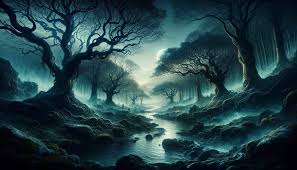
The Mabinogi was written around the early fourteenth century, though many stories within it are likely older, perhaps dating back to the eleventh century or earlier – it is difficult to date oral storytelling traditions, which are the foundations for most medieval or ancient written works. The four tales of the Mabinogi detail the four branches of Branwen, Manawydan, Pwygll, and Math, and each tale is rife with themes of familial and other internal and external conflicts, love and fidelity (even incest), heroism, falls from grace, the supernatural, and trust or loyalty. Though the landscape of the Mabinogi can be geographically situated within the coastal areas of Wales, the supernatural elements of the stories render the spaces described within the stories as liminal and prone to shifting. This tendency brings us back to the concept of the ‘otherworld’, another prominent theme of the Mabinogi. In the medieval poem Sir Orfeo we also find depictions of this hospitable and welcoming ‘otherworld’.
Sir Orfeo is a Breton lai (a rhyming poem of Celtic setting involving some supernatural or paranormal features; its most prominent themes are gallantry, heroism, and love) written around the late thirteenth to fourteenth century, and speaks of King Orfeo and his queen Heurodis. In the poem, Heurodis goes for a nap under a tree in her orchard, and awakes screaming in pain and requesting that her knights restrain her. Her explanation of this event is that the Faery King spoke to her in her dream asking her to leave her life behind and come to the Faery Land, which eventually ends up occurring despite her husband Orfeo’s fervent efforts to stop it. King Orfeo is so heartbroken at the loss of his queen that he decides to leave his kingship behind and live in the forest, which he does for ten years, surviving by means of foraging. Finally, the king sees the faery knights pass through his forest and follows them. He finds himself in a wonderful, enchanted land, filled with music and bright sun. Orfeo spies his wife Heurodis amongst the faery beings, and so asks the Faery King if he can play music to him; if he is good enough, he asks that the king might grant him whatever he wishes. The king agrees. The harp music he plays is so very beautiful that the king says he can have his prize, and Orfeo asks for Heurodis, who is present at the time. After some debate, the Faery King agrees to give him Heurodis, and the two lovers return to their mortal world. When the people of Orfeo’s castle realise that he has indeed returned from supposed death, Orfeo and Heurodis once more rule the land and all is joyous. The ‘otherworld’ of the Faery Land in Sir Orfeo echoes that of the Mabinogi, though with some more sinister elements that emphasise that this is also a land of death:
And in sooth he beheld a fearsome sight;
For here lay folk whom men mourned as dead,
Who were hither brought when their lives were sped;
But the wonder and beauty of this space is that which is most prominent in the account of the Faery Kingdom:
He looked his fill on these marvels all
And went his way to a kingly hall,
And he saw therein a goodly sight;
Beneath a canopy, rich and bright,
The king of the Fairies had his seat
With his queen beside him, fair and sweet,
Their crowns, their vesture, agleam with gold,
His eyes might scarcely the sight behold I
Sir Orfeo gazed for a little space
Several words and lines in this passage imply the space as being in some ways akin to the Christian heaven, such as ‘marvels’, ‘goodly sight’, and ‘his eyes might scarcely the sight behold’, and phrases describing the brightness of the place: ‘Beneath a canopy, rich and bright’, ‘his queen…fair and sweet’, and ‘Their crowns, their vesture, agleam with gold’. The richness and glory of this space are greatly highlighted by the speaker, even beside the images of death that perpetuate it.
A large number of early societies and communities depict in their literature a fearfulness towards transitional or liminal spaces; in Beowulf, the longest known epic poem in Anglo-Saxon English prior to the Norman conquest of the eleventh century, the pastoral is a palpably hostile and violent place, and if one should find oneself within it, one would most likely find one’s death also. The landscape around the ‘The wine-joyous building, brilliant with plating,//Gold-hall of earthmen’, which is the home of the characters in Beowulf, is depicted dark and sombre, and it is within this unforgiving landscape that we find the monster of Grendel: ‘’Neath the cloudy cliffs came from the moor then//Grendel going, God’s anger bare he’, a blood sucking monster who is eventually defeated by the hero Beowulf. The use of mist and cloud in older works is often used to symbolise a liminal or transient space where supernatural phenomena occur, and we see this in the ‘cloudy cliffs’ from which Grendel emerges from. But even after Beowulf gloriously slays the monster Grendel, all is not yet well; Grendel’s mother, an equally monstrous being who lives in a lonely mere in the forest, comes seeking revenge for her son’s death: ‘the mother of Grendel,//Devil-shaped woman, her woe ever minded,// Who was held to inhabit the horrible waters,//The cold-flowing currents’. We encounter here the ‘underworld’ aforementioned; Grendel’s mother lives beneath the earth’s surface, in the dark cold of still water away from the safety of civilisation. This liminal space, though akin to the ‘otherworld’ of the Mabinogi in that it is accessible to man in life (unlike the hell of Christianity), it is differentiated from the ‘otherworld’ in that it is an isolated, fear-inducing, and dangerous place. Hrothgar, the Danish King (the hero Beowulf is king of the Geats), describes Grendel’s mother’s habitat to Beowulf in XXI of the tale:
Fearfullest fen-deeps, where a flood from the mountains
’Neath mists of the nesses netherward rattles,
The stream under earth: not far is it henceward
Measured by mile-lengths that the mere-water standeth,
Which forests hang over, with frost-whiting covered,
A firm-rooted forest, the floods overshadow.
In this passage, we can sense the terror of Hrothgar in the adjective ‘fearfullest’, and we are also reminded of the hostility of the landscape wherein Grendel’s mother dwells. Words such as ‘fen-deeps’, ‘[be]’Neath’, ‘under’, and ‘overshadow’ further imply the stark differences between the ‘otherworld’ of the Mabinogi and the ‘underworld’ here described. Interestingly, this passage also utilises winter imagery to increase the aggression and anti-human sentiment of Grendel’s mother’s home: ‘forests hang over, with frost-whiting covered’, suggestive of the dangers commonly associated with the colder seasons before industrialisation. We discover here that this place is ‘not far’ from the banquet-hall wherein Hrothgar addresses Beowulf, which suggests the aspect of liminality in the tale; danger and depraved supernatural powers are to be found close if not within the landscape that one might deem safe or call ‘home’. This land is perpetually haunted by the ‘underworld’ that it contains.
The ‘otherworld’ that we find in Sir Orfeo and the Mabinogi is indeed as accessible to the human as the ‘underworld’ is here in Beowulf, but the stark differences in the imagery used by these texts is that which implies a spiritual and psychological difference between the imagined veracity of these spaces. These differences can be compared to biblical verses recounting both heaven and hell, such as this passage from Revelation 21:8:
But as for the cowardly, the faithless, the detestable, as for murderers, the sexually immoral, sorcerers, idolaters, and all liars, their portion will be in the lake that burns with fire and sulfur, which is the second death.
As we can see here, the lake of fire, whilst bearing a significant temperature difference to the lake of Beowulf, is equally perilous to those who encounter it as the lake is to the hero Beowulf. However, while Beowulf’s bravery is that which enables him to conquer and enter the lake in the tale, the lake of fire welcomes only those of odious moral standing. Now, observe this contrasting depiction of heaven in Revelation 22:1-5:
Then the angel showed me the river of the water of life, bright as crystal, flowing from the throne of God and of the Lamb through the middle of the street of the city; also, on either side of the river, the tree of life with its twelve kinds of fruit, yielding its fruit each month…And night will be no more. They will need no light of lamp or sun, for the Lord God will be their light, and they will reign forever and ever.
In this glorious passage, we can ascertain some similarities to the ‘marvels’, ‘gold’, and ‘canopy’ of Sir Orfeo, and indeed to the Mabinogi. In the first branch of the Mabinogi, Pwyll witnesses the wonder of the ‘otherworld’ (of Annwn), which is governed by Lord Arawn: ‘the most beautifully adorned buildings anyone had ever seen’, and ‘the most beautiful woman that anyone had ever seen’ (referring to Arawn’s queen). The relationship between the ‘otherworld’ of the Mabinogi, which is founded in ancient Celtic paganism, and that of Christianity, is intriguing; we have observed physical similarities between them, but this statement in Matthew 5:12 marks the primary difference between these worlds:
‘your reward is great in heaven[.]’
This line embodies the spiritual and physical differences between the ‘otherworld’, ‘underworld’, ‘heaven’, and ‘hell’. ‘Heaven’ here has moral weight in that it is only achievable to those who have lived their lives and died a certain way – the ‘otherworld’ and ‘underworld’ have no such limitations. Furthermore, the space of heaven is not liminal in the same way that the ‘otherworld’ is to Pwyll in the Mabinogi, or to Sir Orfeo, or even to Beowulf, whereby the characters in these tales can almost seamlessly pass into and through these enchanted spaces regardless of whom they happen to be. Ideologically, these tales suggest the intrinsic link between man, landscape, and history, in that magic itself can be found not far above (as in heaven) or far under (as in hell), the earth that we dwell upon.
I’m not entirely sure what I wished to discover or enlighten you to with this article. I learned as I wrote, just as you have done as you have read, returning to passages in books and figuring out what it is I wanted to say. I find these ideological differences in life after death or simply in magical spaces to be deeply fascinating, and I hope that you have found this a thought-provoking discussion.
=========
The Carl Kruse Blog homepage is at https://www.carlkruse.com
Contact: carl AT carlkruse DOT com
Previous articles by Hazel include VE Day, On Friendships, and Whoredom and Harlots.
Also find Carl Kruse at Berkeley’s BOINC Number Fields project.